Dr. Les Anderson Explains V-Flex
This is a great introduction to V-Flex at Bellarmine University in KY. If you’ve purchased a V-Flex hitting system this video is a must for your Baseball Training and Softball Training needs. Make sure your players get an opportunity to watch these and ask questions. They need to know how to use V-Flex correctly so they can pass it on to the next generation of V-Flexers.
The Basics of Softball Training
- Minimize verbal feedback
- Success= swing at strike
- Throw no more than three strikes in a row
- Mix speed and location
- Throw “balls” 2-3 feet from strike zone
- Maximum of 10 swings per set
- Use with pitching machine is OK
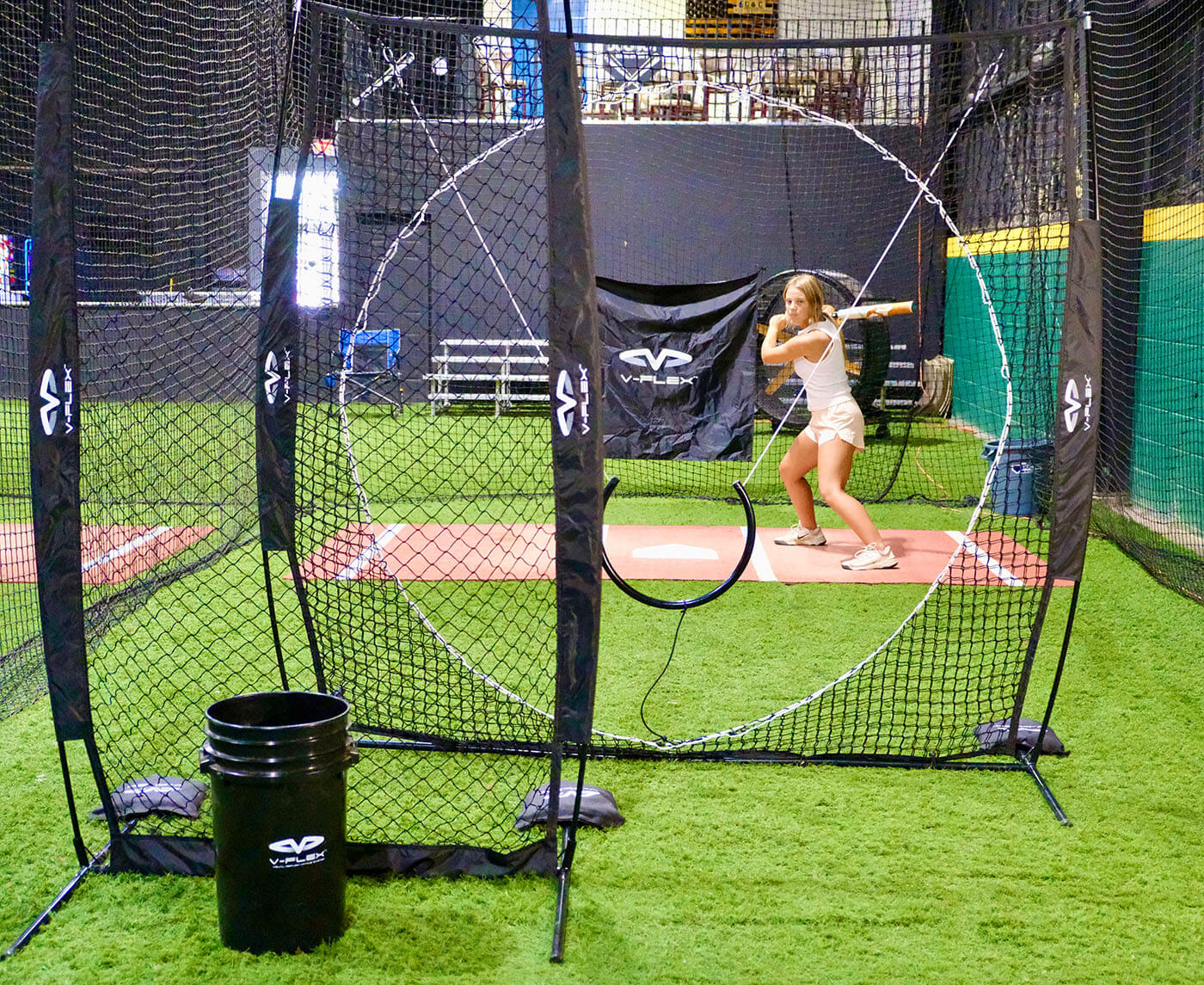
Front Toss consist of placing the V-Flex device approximately 12′ from the front of home plate. The safety screen 3′ goes behind it to protect the pitcher. The speed of the tossed ball should be relatively fast. (No lazy tosses) You are conditioning a visual reflex, thus the pitches should command the hitters attention.
Vary distances weekly between 12′ and 20′ in cage work and 25′ to 35′ for on field BP. *Remove cables and ring system for longer distances. We recommend using the pieces between three to five days per week. this is also true on the Baseball Training side of things
The main objective when introducing V-Flex to your team is to provide them with a basic understanding of the strike zone as it relates to pitch efficiency. Explain the difference between “strike recognition” and pitch recognition. The brain doesn’t have enough time to determine pitch type and cognitively choose to swing at certain pitches therefore V-Flex trains hitters to recognize a strike regardless of the pitch type (curve, change, slider, etc).
V-Flex enhances the space the pitches are traveling through so hitters can assimilate spatial information faster. The six softballs that fit inside the V translate into a core hitting zone at home plate. This allows them to self-adjust and gain confidence in their own abilities to swing at strikes.
The User’s Manual includes advanced training tips and techniques. If you have specific questions about the implementation process, feel free to contact us by clicking here
Advanced Understanding of Strike Recognition
Internal Reward Systems for Softball and Baseball Training
New findings in neurology reveal that forcing the brain to predict outcomes releases neurotransmitters that facilitate faster learning and enhanced performance. We limit the number of strikes during training because repetition is inefficient for a developing brain. Instead, implicit training methods ensure the correct release of neurotransmitters. It’s crucial that pitch patterns remain unpredictable because the brain dislikes repetition.
Incentive salience is a motivational “wanting” attribute given by the brain to reward-predicting stimuli. This “wanting” is different from “liking,” which is the immediate pleasure gained from contact with stimuli. The “wanting” of incentive salience acts as a motivational magnet, transforming a pitch from a mere sensory experience into something that commands attention, induces approach, and makes it a sought-after goal.
The pitches identified in the (V) represent an area that commands visual attention and is considered a conditioned stimulus. When hitters swing at these pitches, we have a conditioned response. The main goal is to train hitters to swing at strikes, and this implicit approach to strike zone development is capable of producing exceptional results.
Creating a better learning space requires altering the brains perception of the space between home plate and the pitchers mound. It doesn’t have anything to do with the swing or a hitting mechanics. Provide the hitters brain with a more efficient method for processing information and you will see a transformed hitter.
REAL “Separation” in Depth for Softball and Baseball Training
Precise depth perception is central to the art of hitting. Normal human depth perception is relative to the space and objects being perceived. Optical disparities within the visual system give rise to normal 3D vision. V-Flex enhances depth perception by altering certain depth values during batting practice. These values are central to visually guided actions. The qualitative experience of stereopsis is expressed in a more vivid impression of tangible solid forms, immersed in negative space for the purpose of deriving a “real” separation of depth (absolute depth). By assisting hitters with distinct spatial parameters they develop faster and more efficient strike recognition skills. The expression of these behaviors translate into better game day performances simply because the regions of the brain responsible for visually guided responds have been implicitly engaged during practice. Hitters respond to strikes more consistently when the correct visual information is provided.
Reinforcing Behaviors
There are several ways to reinforce a learned behavior. We recommend removing the primary visual training cables and ring (or) v-rods to allow the brain to exercise with a “relative space” associated with pitch recognition.
There is a fine line between training and reinforcement. One without the other limits the synergistic effect of real time training. Our main functional objective is to provide you better alternatives for training and developing players through implicit training methods.
The Basics of Baseball Training
- Minimize verbal feedback
- Success= swing at strike
- Throw no more than three strikes in a row
- Mix speed and location
- Throw “balls” 2-3 feet from strike zone
- Maximum of 10 swings per set
- Use with pitching machine is OK

Overhand Baseball Training consist of placing the VX-4 approximately 18′ from the front of home plate. The safety screen should be placed 5′ behind it to protect the pitcher. The speed of the pitch should be relatively fast. You are conditioning a visual reflex, thus the pitches should command the hitters attention. Vary distances weekly between 15′ and 25′ in cage work and 30′ to 40′ for on field BP. We recommend using the pieces between three to five days per week.
The main objective when introducing V-Flex to your team in your Baseball Training program is to provide them a basic understanding of the strike zone as it relates to pitch efficiency. Explain the difference between “strike recognition” and pitch recognition. The brain doesn’t have enough time to determine pitch type and cognitively choose to swing at certain pitches therefore V-Flex trains hitters to recognize a strike regardless of the pitch type. (curve, change, slider, etc) We do this by enhancing the space the pitches are traveling through so hitters can assimilate spatial information faster. The 7 baseballs that fit inside the V translate into a core hitting zone at home plate. Allow them to self adjust and gain confidence in their own abilities to swing at strikes. There are advanced training tips and techniques in the User’s Manual that comes with the pieces.
If you have particular questions about implementing the process in your Baseball Training or softball Training program just contact us.